
Watch the recording
You've been working in the charity sector for years, now you’re freelancing. You're good at what you do.
But you’re replying to emails on your day off and carrying client problems around in your head long after you've shut your laptop.
What if you could build a business that gives you better choices, about which clients you work with, what you charge, and when you stop for the day?
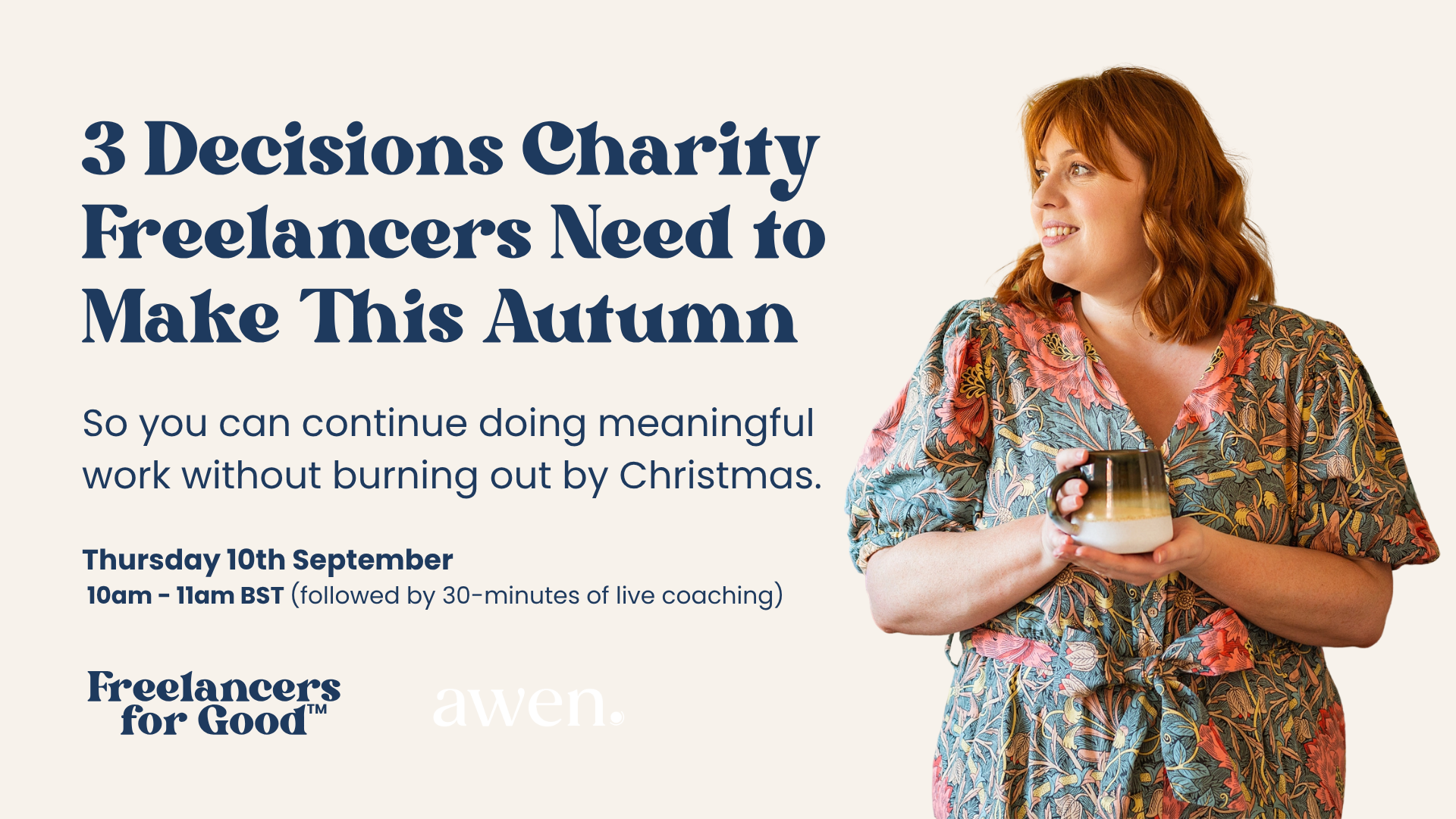
3 Decisions Charity Freelancers Need to Make This Autumn
📅 Date: Thursday 10th September
🕛 Time: 10am - 11am BST
Followed by 30 minutes of free live coaching
📍 Where: Live on Zoom
Join me live for a free workshop for charity freelancers who want to do good work, on their own terms.
The recording will be available for 48 hours, but if you can, join live. The live coaching and Q&A at the end won't be included in the recording.
Does this feel familiar?

You wanted a full calendar of clients, and blimey, you got it. And now you're too busy, and bloody exhausted, which is not how any of this was supposed to feel.
You wanted the freedom to do a yoga class in the middle of the day, or the school run without asking anyone's permission. You wanted to do good work for good organisations on your own terms, and by most measures you have done exactly that.
Which should feel like success, right? But instead you're replying to client emails on your day off, squeezing "just one more thing" into projects that were already full, saying yes before you've had a chance to ask whether you actually want the work and carrying client problems around in your head long after you've shut your laptop.
And everything you've been meaning to do for your business, like reviewing your prices, refining your services, planning ahead, marketing yourself, continuously keeps getting pushed to Friday, then next week and then next month.
Because client work comes first, again, then another enquiry arrives and instead of asking, "Is this the right opportunity for me?" you find yourself wondering, "How on earth could I fit this in?"
Being busy is not the thing that's gone wrong here.
In many ways, it's the thing you've worked for. You've built a reputation good enough that people recommend you without being asked, clients come back a 2nd and 3rd time, and organisations trust you with the work that actually carries some risk for them. After years of proving yourself, that's worth being properly proud of, and I don't want to skip past it.
There does come a point, though, where the challenge changes shape. Getting clients stops being the hard part, and the hard part becomes whether your business can carry the number of clients you've already agreed to work with, or whether the whole thing only stands up because you're standing underneath it, holding it all up with buckling knees.
Because when it's you holding it up, you end up being everything at once, the safety net, the project manager, the relationship manager, the person who sets the boundaries and then the person who breaks them at 9pm on a Thursday, the finance team, the strategist, and the one making every uncomfortable decision on your own, usually on a Sunday afternoon with a cup of coffee going cold next to you.
During this free workshop…
I will guide you in making the 3 Decisions Charity Freelancers Need to Make This Autumn, so you can continue doing meaningful work without burning out by Christmas.
1. Identify what work you're going to stop doing for free.
Most of us work out our capacity by counting the days we've sold, which is a perfectly reasonable way to do it right up until you notice that the days you sold are not the days the work actually took.
You're also writing the briefs your clients should have written, doing the stakeholder management nobody scoped, and absorbing a third round of amends you never quoted for, because the charity is lovely and underfunded and you don't want to be the freelancer who invoices for an extra call.
Add the context switching between 6 organisations, each believing they're your only client, and the "quick questions" that have been eating into your ‘Business Development Fridays’ since June. You can see how 3 days of solid work turns into a full week without anybody deciding that it should.
In this first part, we go through the work that no invoice has ever mentioned, so that you can see the honest shape of your week and make decisions about what to take on with that in front of you, rather than a number you sold back in the spring.
The decision: which piece of unpaid work you stop doing, or start charging for, before your autumn feels unmanageable.

2. Make room for your own business development.
When client work always gets the best of your time and energy, your own business gets whatever is left at the end of the day, which most days is nothing at all.
So your marketing stops, and then restarts in a panic when projects end. Your prices stay exactly where you set them 18 months ago, on a Sunday, with a calculator, even though you worked out then that they were actually too low. And business development becomes the thing you'll get to when things calm down; when the truth is that things don't calm down, that’s when panic sets in.
Every freelancer I work with has built their business one yes at a time, which is precisely how it should be built at the beginning, and then never went back and redesigned it once getting more work had stopped being the problem.
In this part we look at how to make enough room to do that redesign, so that when the next inquiry lands in your inbox you get to ask whether you actually want it, instead of immediately working out how on earth you'd fit it in.
The decision: which one thing comes out of your September, so that the pricing review or the marketing finally gets your focus, because nothing new goes into a full week until something else leaves it.

3. Who is going to know your business as well as you do by Christmas.
Freelancing gives us our independence, and the price of that independence is that every decision with real money attached gets made by one person, often late in the evening, with nobody to check the logic. Whether to put a rate up. Whether to walk away from a client you genuinely like, who also happens to have recommended you to two others. Whether a quiet fortnight in October is a blip or the beginning of something you should be worried about.
I'm not going to tell you to build a team or buy another piece of software you'll spend the next 6 months fighting with. Most experienced charity freelancers assume that what's missing is more capacity, when what's actually missing is somebody looking at their business with them at the moment a decision gets made.
So in this part we go through what changes when you have that: how much faster you put your rates up, how much earlier you spot the client who's going to become a problem, and how differently a year goes when you stop working all of it out on your own on a Sunday evening.
The decision: who are you going to bring up to speed now, so that in January you're not the only one who understands what's going on.

This workshop is for you if...
You find it genuinely difficult to say no, even when you can already see that your capacity is stretched and you know exactly what saying yes will cost you.
You'd like to earn more money without the only available route being more days, more evenings and more of you.
Your own business is always the thing that gets bumped, because the client work has a deadline attached and your pricing review doesn't.
You regularly find yourself doing work that was never really in the brief, and you've stopped bothering to mention it.
You already know which changes you need to make, and you cannot find the time or the headspace to make any of them.
You miss having people around you who understand your business well enough to sense-check the difficult decisions before you make them.
If you've read several of those and felt a bit seen, come along. This is about building a business that gives you better choices about which clients you take on, what you charge them, and what time you shut your laptop.
This workshop probably isn't for you if...
You're looking for help winning your very first freelance client, in which case this will be aimed a few years ahead of where you are.
You want productivity tips so you can fit even more work into a week that is already full to the gunnels.
Your ambition is to grow as fast as humanly possible and worry about the consequences later.
Your plan involves earning millions from a laptop on a beach in Bali.

Hi, I’m Bethany
Coach, business mentor and consultant, working with charity freelancers to build businesses that deliver impactful services and provide steady, diverse income, without hustling or burning out.
I've worked in the charity sector since 2010, going freelance in 2020, and I now run Freelancers for Good™, a programme that helps charity freelancers redesign their business model, their services and their workload, so the work stops taking over every corner of the week and starts feeling like something they can actually enjoy.
The thing I've become properly fascinated by, after 6 years of coaching charity professionals and freelancers, is what happens when experienced charity people go freelance.
We leave the job, the manager and the organisation, and we take the plant we had on our desk and all our old working habits with us, including the urgency, the over-responsibility, the instinct to be helpful before anyone has even asked, the physical dread of disappointing somebody who is doing important work on not enough money, and the reflex to give a bit more of yourself because the cause makes a real difference to real people.
Those habits are a large part of why we're so bloody good at this. They're also why so many of us are exhausted by Friday.
I built Freelancers for Good™ because there's another way to do this, one where you do meaningful work, earn properly, care deeply about your clients, and still have a business that stands up on its own rather than one that only functions because you're permanently stretched across it holding it together.
And that's what we'll start deciding together in this workshop.

One final thought...
For years the definition of success handed to charity freelancers has been more. More clients, more work, more growth, more of everything, forever. What almost every experienced freelancer I speak to actually wants is enough: enough income to stop doing sums at 11pm, enough confidence to say your rate out loud without softening it, enough boundaries that your Fridays belong to you, enough space to think about your business, and enough energy left to enjoy the thing you've spent years building.
If that's the business you want, come and join us. And you certainly don't need me to tell you that boundaries are a good idea. The hard part is building them in when there's real money, real relationships, real causes and years of client goodwill sitting on the other side of the decision, and that's exactly the conversation I want to have with you on the 10th of September.